

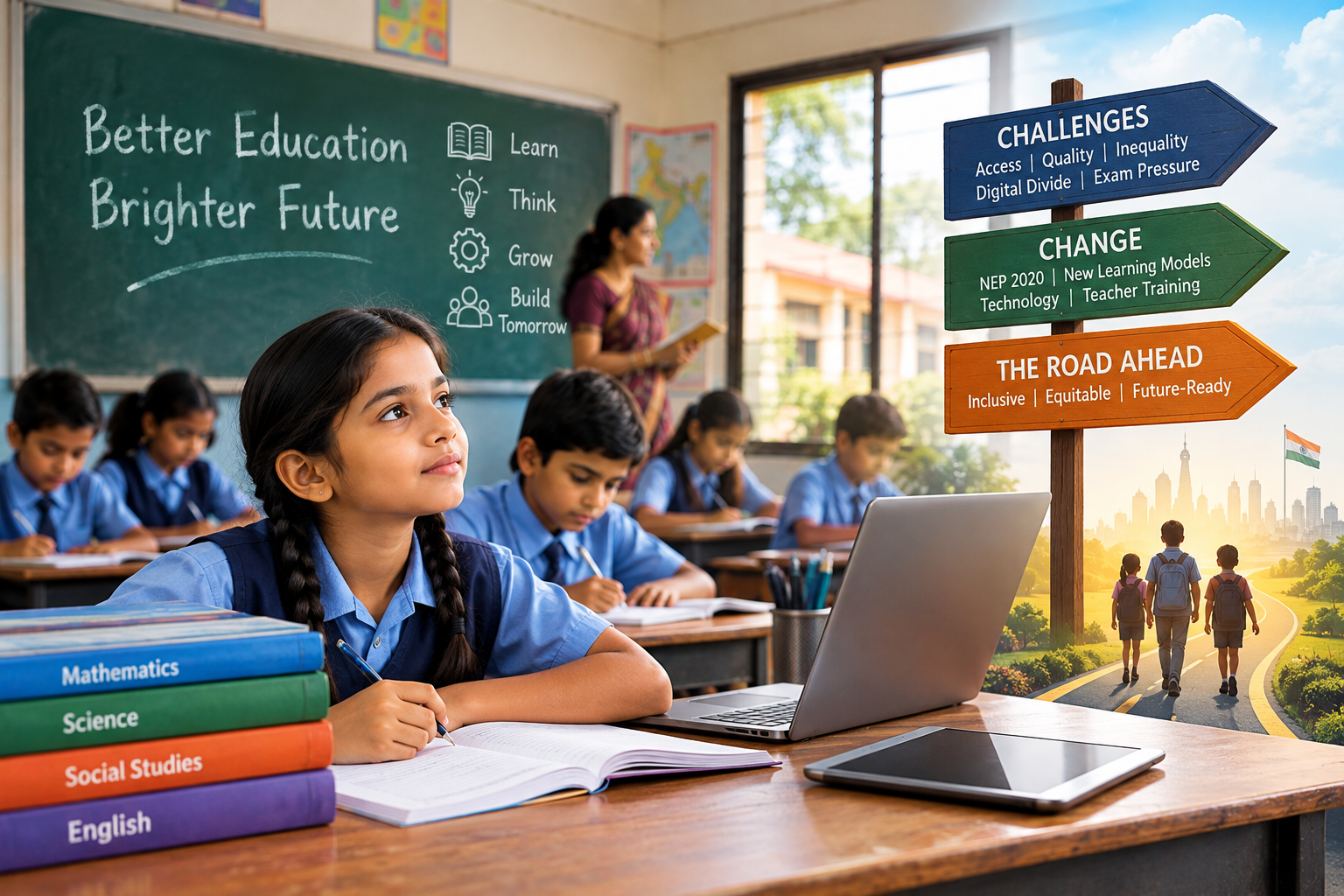
New Delhi: India’s education system is standing at an important turning point. Over the years, millions more children have entered classrooms, access to schooling has expanded and new technology has opened doors that once seemed far away. Yet, behind these gains lies a difficult question: are children learning enough, and are they being prepared for the world they will enter tomorrow?
The answer is not simple. India has made clear progress in getting children into school. The ASER 2024 survey found that 98.1 per cent of children aged 6 to 14 in rural India were enrolled in school. At the same time, the report shows that learning levels, though improving, remain an area that needs sustained attention. For example, 23.4 per cent of rural government-school children in Class III could read a Class II-level text in 2024, up from 16.3 per cent in 2022.
This tells an important story. Getting children into classrooms is only the first step. What happens inside those classrooms matters just as much.
The National Education Policy, introduced in 2020, has tried to address this gap by placing greater emphasis on basic reading, mathematics, practical learning and a broader development of children. It also proposed a new 5+3+3+4 structure covering education from the early years through secondary school.
But turning policy into everyday classroom practice is never easy. India is a huge and diverse country, with schools facing very different realities. Some have smart classrooms, good libraries and access to computers, while others still struggle with basic facilities, teacher shortages or limited learning resources. The digital divide has also become harder to ignore. A child with a smartphone, stable internet and a quiet place to study has advantages that another child may simply not have.
There is also the pressure of examinations. For many students, marks still become the main measure of success. Coaching centres, entrance tests and intense competition can leave little room for curiosity, creativity or simply learning at one’s own pace. Education should certainly prepare young people for careers, but it should also teach them how to think, question, communicate and solve everyday problems.
Teachers remain at the heart of this change. Better training, reasonable workloads and greater support can make a real difference. Technology can assist teachers, but it cannot replace the patience and understanding of a good teacher.
The road ahead, then, is not about choosing between old and new. India needs both strong foundations and new ideas. It needs classrooms where children can read with confidence, understand numbers, use technology wisely and still have the freedom to ask, “why?”
The challenge is large, but so is the opportunity. If India can turn its education reforms into meaningful changes in everyday classrooms, the result will not just be better examination scores. It could shape a generation that is more capable, confident and ready for a rapidly changing world.
