
New Delhi: For generations, the familiar picture of Indian education has been simple: attend school, pass examinations, earn a degree and then look for a job. But that path is changing. Slowly, and with a few bumps along the way, India is beginning to ask a bigger question — is education preparing young people only to pass exams, or to actually build a life and a career?
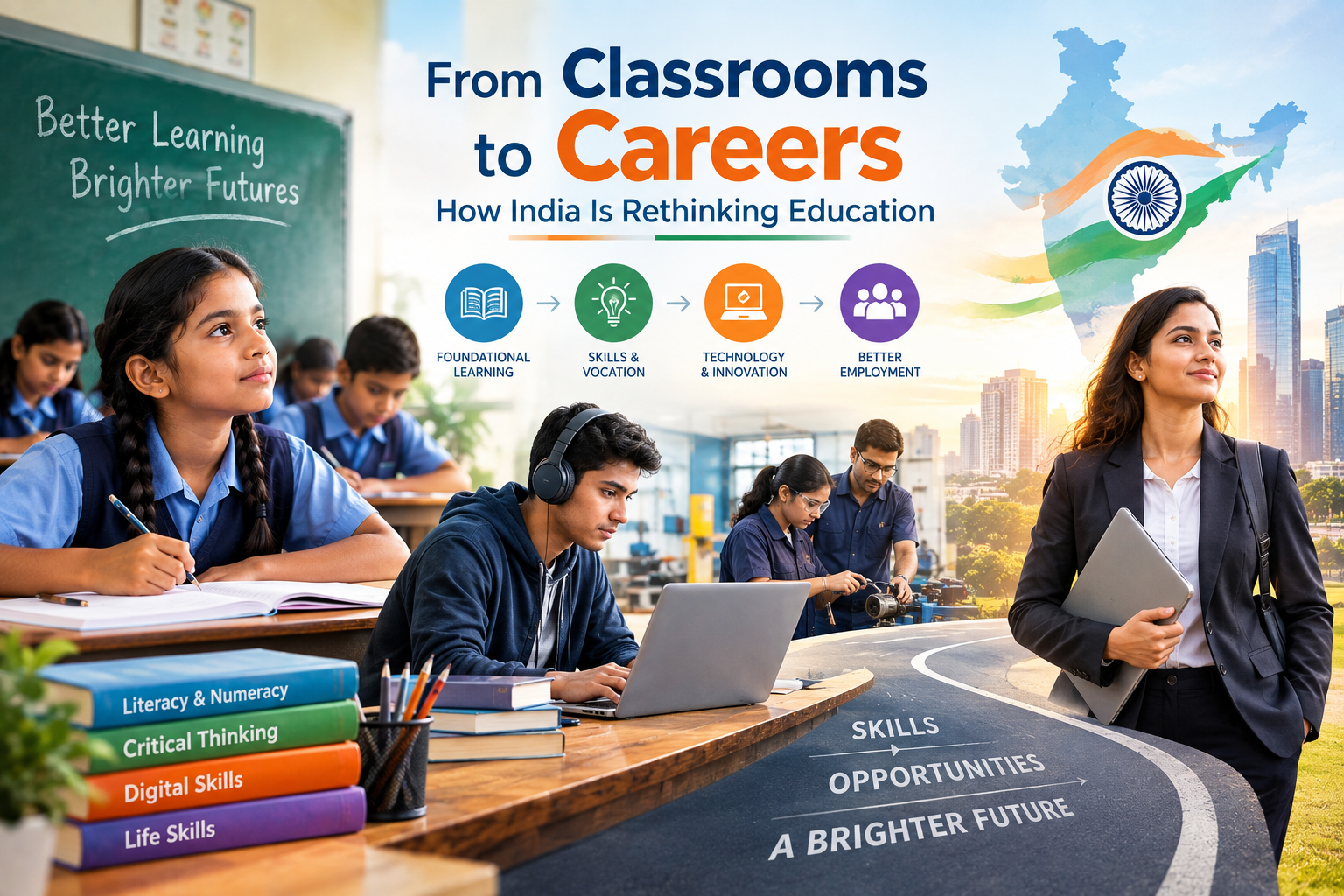
The shift is visible from the early years of schooling itself. The National Education Policy (NEP) 2020 places greater attention on foundational reading and mathematics, early childhood education, practical learning and the development of skills alongside academic knowledge. It also calls for vocational education to become part of mainstream education rather than something viewed as a second choice.
That change is important because India’s classrooms are dealing with a basic challenge first: learning. The ASER 2024 survey found that 98.1 per cent of rural children aged 6 to 14 were enrolled in school, showing how far access to education has expanded. Yet learning levels remain uneven. In 2024, 27.1 per cent of rural Class III children could read a Class II-level text, compared with 20.5 per cent in 2022. The improvement is encouraging, but it also shows there is still a long road ahead.
And then comes the question of employment. A degree by itself does not always guarantee a smooth entry into the workplace. Employers increasingly look for communication, problem-solving, digital knowledge and practical experience. This is pushing colleges and universities to think more seriously about internships, industry exposure, vocational courses and skills that students can actually use.
Technology is becoming another part of this transformation. Smartphones, online learning platforms and digital classrooms have opened new possibilities, particularly for students who may not have access to specialised teachers or institutions nearby. But technology is not a magic solution. The digital divide remains real, especially where internet access, devices and quiet spaces for study are limited.
Teachers, meanwhile, remain central to the entire process. A new curriculum or a new app can help, but neither can replace a teacher who understands what a student is struggling with. Better training and support for teachers will therefore matter as much as new policies and technology.
India’s education journey is, in many ways, moving from memorising answers towards understanding how to use knowledge. The change will not happen overnight. Schools differ widely, colleges face their own pressures, and millions of students come from very different social and economic backgrounds.
Still, the direction is becoming clearer. Education is no longer only about what a student knows on the day of an examination. It is increasingly about what that student can do afterwards — in a workplace, in society and in everyday life.
The real test now is implementation. If India can connect good teaching with useful skills, affordable technology and meaningful career opportunities, the journey from classroom to career could become much smoother. And that, perhaps, is where the next big chapter of Indian education will be written.
