

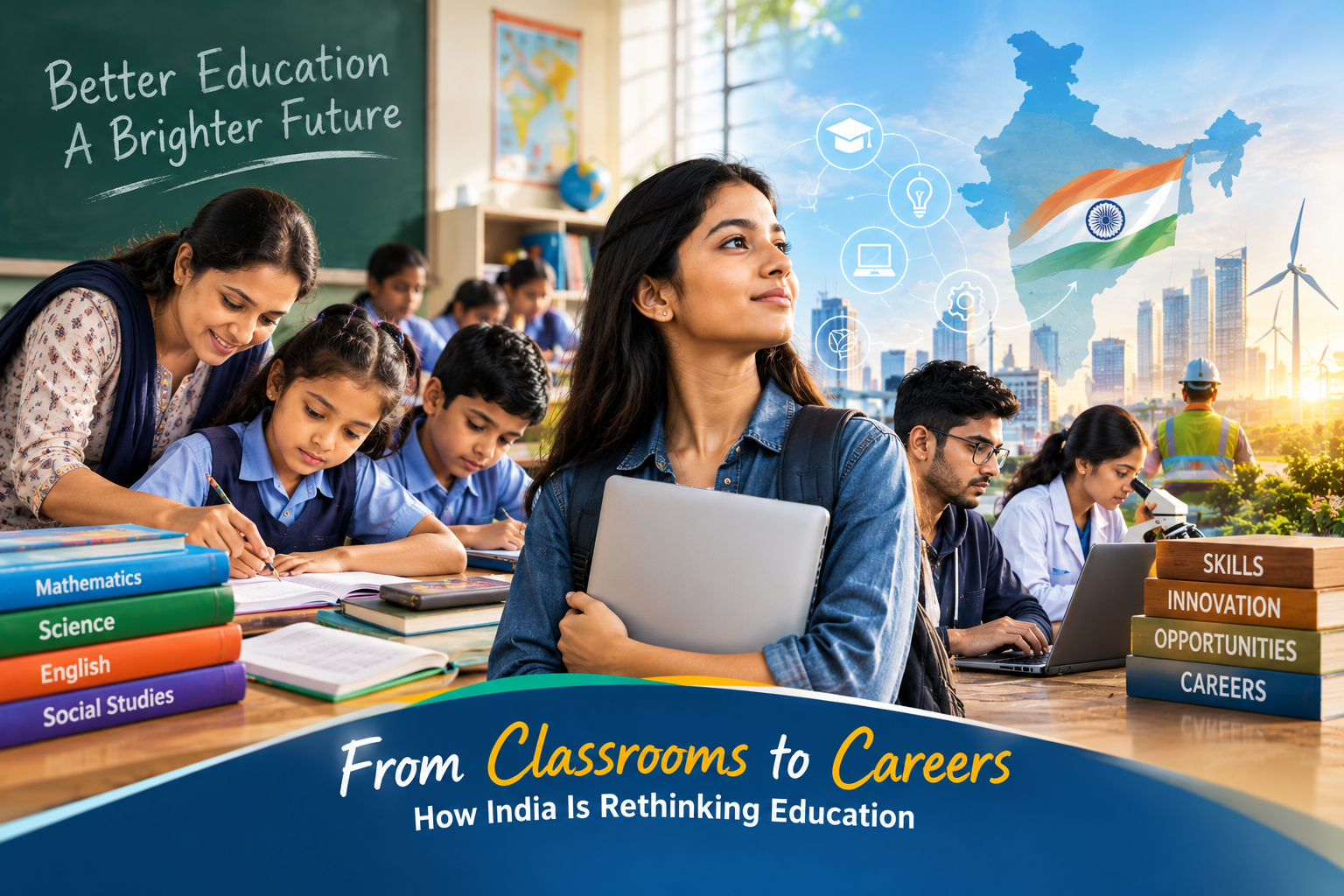
New Delhi: India’s education story is no longer simply about getting children into classrooms. The bigger challenge now is what they learn there, how they learn it and whether that learning prepares them for a world that is changing almost every day. With a huge and young population, India has an opportunity that few countries can match. But turning that opportunity into a strong education system will require more than new buildings, new textbooks or new technology.
Over the past two decades, school access has expanded considerably. The focus, however, is gradually moving from enrolment to learning. The ASER 2024 survey found that 98.1 per cent of rural children aged 6 to 14 were enrolled in school. It also reported a recovery in basic reading and arithmetic levels after the disruption caused by the pandemic. In rural India, the share of Class III children able to read a Class II-level text rose to 27.1 per cent in 2024, from 20.5 per cent in 2022.
The numbers show progress, but they also point to the distance still to travel. A child being present in school is not the same as a child learning well. Foundational reading, writing and mathematics have to become the base on which everything else is built. Without that foundation, later lessons — whether in science, technology or vocational education — become much harder to follow.
The National Education Policy 2020 has attempted to change the direction of Indian education by giving greater importance to early childhood learning, basic skills, practical knowledge and vocational education. The government’s NIPUN Bharat mission, launched in 2021, also focuses on ensuring that children gain basic reading and mathematics skills in the early years.
Technology will have a role too. Digital classrooms, online resources and artificial intelligence can make learning more flexible and open access to knowledge. But technology should remain a tool, not the answer to every problem. A tablet cannot replace a good teacher, and an online lesson cannot always replace the encouragement a child receives inside a classroom.
Teachers, in fact, may be the most important part of the entire reform. Better training, manageable workloads and greater support can help teachers spend more time teaching and less time struggling with administrative pressures. Schools also need to create room for questions, discussion and practical learning, instead of making examinations the centre of everything.
There is another challenge — inequality. A child in a well-equipped urban school and a child in a remote village may technically belong to the same education system, but their daily experiences can be very different. Closing that gap will require sustained investment and attention, not quick fixes.
India cannot build a future-ready education system overnight. It will take patience, better teaching, stronger foundations and a willingness to learn from what is actually happening in classrooms.
The ambition, though, is worth pursuing. If education can move beyond memorising answers and help young Indians read confidently, think clearly, use technology wisely and develop useful skills, the classroom can become more than a place of study. It can become the starting point for a more capable, confident and prepared generation.
