

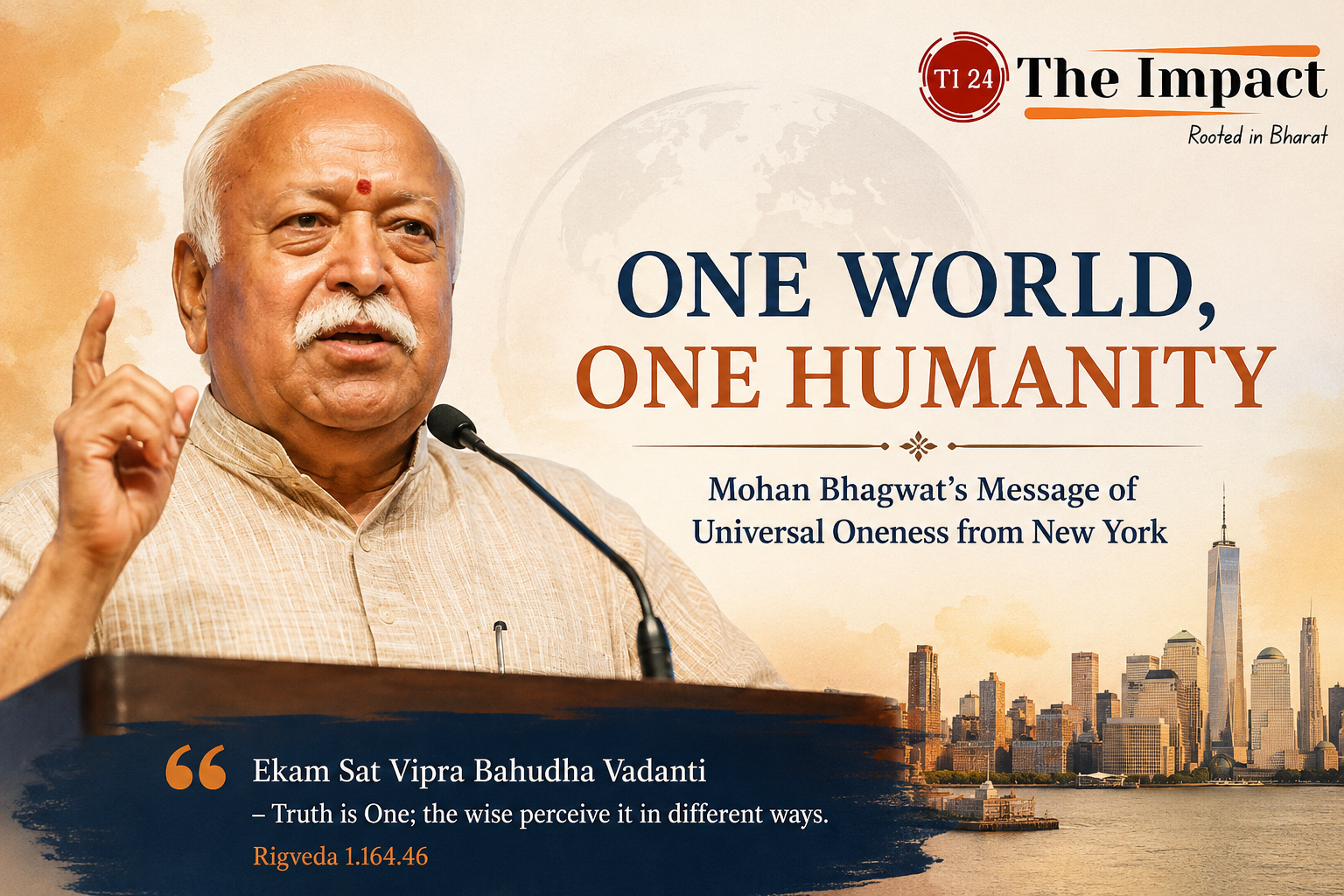
The world today stands at a paradoxical crossroads. Technology has brought humanity closer than ever before, yet societies continue to witness religious tensions, wars, ideological divisions, intolerance and mistrust. In such a moment, the message emerging from New York on August 29 carries significance far beyond the walls of a religious summit: humanity may follow different paths of faith, but its fundamental aspirations are shared.
The “One World: One Humanity” Summit, organised under the aegis of the World Council of Religious Leaders, brought together around 200 religious leaders from different faith traditions across the world. The gathering culminated in a five point Call to Action, reflecting a collective recognition that religious leadership must contribute more actively to peace, harmony, human dignity and global cooperation.
Among the voices at the gathering, the message of RSS Chief Mohan Bhagwat deserves particular attention, not merely because of his institutional position, but because he invoked one of India’s oldest philosophical ideas:
“एकं सत् विप्रा बहुधा वदन्ति”
The ancient Sanskrit expression, found in the Rigveda, conveys a profound thought: Truth is One; the wise describe or perceive it in different ways. The beauty of this idea lies in its ability to recognise diversity without turning diversity into conflict. Human beings have understood the Divine in different ways. Some call it God, some Allah, some Brahman, some approach it through spiritual enlightenment, while others understand the ultimate reality through different philosophical traditions. The names, rituals and theological interpretations may differ, but the fundamental human search for truth, peace, compassion and meaning remains remarkably similar. “Ekam Sat Vipra Bahudha Vadanti” does not necessarily suggest that every religious doctrine is identical. Rather, it encourages a broader civilisational attitude: one can remain firmly rooted in one’s own faith while respecting another person’s right to seek truth through a different path.
That distinction is extremely important in today’s world.
For centuries, religious identities have contributed immensely to human civilisation, shaping ethics, art, philosophy, charity and social institutions. Yet religion can become a source of division when faith is transformed into hostility toward others.
The answer is not to diminish religion, but to promote a culture in which faith becomes a bridge rather than a barrier. This is where gatherings such as the New York summit acquire relevance. When religious leaders from diverse traditions sit together, listen to one another and jointly speak about humanity’s shared challenges, they demonstrate that disagreement does not have to result in hostility.
The challenges confronting humanity are increasingly global. Climate change, poverty, displacement, technological disruption, extremism, war and social polarisation do not respect religious or national boundaries. A bomb does not distinguish between religions. A natural disaster does not ask about someone’s faith. Poverty does not carry a religious identity. And a child’s aspiration for peace, dignity and a better future is universal. Religious leaders possess a unique influence in this regard. They can shape public attitudes, inspire communities and reach millions of people beyond the boundaries of political institutions. Their responsibility should therefore extend beyond defending religious interests to actively promoting peace, dialogue, compassion and human dignity. India has historically nurtured a philosophical tradition that accommodates plurality. Ideas such as “वसुधैव कुटुम्बकम्” the world is one family and “एकं सत् विप्रा बहुधा वदन्ति” represent a worldview in which diversity is not necessarily perceived as a threat.
The invocation of this ancient wisdom at a global gathering in New York is therefore significant. It presents an opportunity to place India’s civilisational philosophy within a contemporary global conversation. But ancient wisdom becomes meaningful only when translated into modern conduct. It is easy to speak about universal brotherhood from a podium. The real test is whether ordinary people can practice it in their daily lives whether we can disagree without hatred, debate without humiliation and follow our own faith without disrespecting another.
The five-point Call to Action emerging from the summit should not remain merely a declaration of religious leaders. Its real value will depend on how effectively its principles are carried into communities. Schools can teach young people the value of interfaith understanding. Religious institutions can strengthen dialogue and reject hatred. Civil society can create platforms for communities to work together. Governments can protect freedom of faith while ensuring that religious differences do not become instruments of violence. Most importantly, individuals must recognise that being different does not make another human being less worthy of dignity.
“One World: One Humanity” should not mean that humanity must become culturally or religiously uniform. Uniformity is neither possible nor desirable. The real objective should be unity without uniformity a world where different faiths, cultures, languages and traditions can coexist while sharing a commitment to peace and human dignity. This is perhaps the deeper relevance of एकं सत् विप्रा बहुधा वदन्ति. Our understanding of the ultimate truth may differ; our methods of worship may differ; our cultural expressions may differ. Yet our responsibility toward one another remains.
The New York summit, therefore, offers a message that deserves to travel far beyond the gathering itself: we do not have to abandon our identities to embrace humanity. We simply have to recognise that our identities are many, while our shared human destiny is one. In an increasingly divided world, that may be one of the most powerful forms of wisdom we can rediscover.
