Close Menu

    Subscribe to Updates

    Get the latest creative news from FooBar about art, design and business.

    What's Hot

    Captain Smit Machchhar: A Pilot’s Journey, Courage and Commitment

    October 5, 2026

    Medicinal & Aromatic Plants Cultivation Promoted for Livelihood Security in Dima Hasao

    September 23, 2026

    Sensitization-cum-Training Programme on Self-Financing System Concludes at KVK Jammu

    September 17, 2026
    Facebook X (Twitter) Instagram
    theimpact24.com
    • Home
    • About Us
    • Bharat
      • Agriculture
      • Environment
      • Education
      • Health
      • Business
      • Entertainment
      • Science & Tech
      • Sports
      • Political
      • Lifestyle
      • Culture
    • Opinion
    • Popular Article
    • KRISHI CONNECT
    • JOBS
    theimpact24.com
    • CONTACT US
    • ADVERTISE
    • NEWS DESK
    • PRIVACY POLICY
    • TERMS & CONDITION
    Home » Melting Himalayas, Rising Flood Risks: Nepal’s Mountain Future Under Climate Pressure
    Environment

    Melting Himalayas, Rising Flood Risks: Nepal’s Mountain Future Under Climate Pressure

    Impact Digital DeskBy Impact Digital DeskSeptember 2, 2026No Comments3 Mins Read
    Facebook Twitter Pinterest LinkedIn Tumblr WhatsApp VKontakte Email
    Share
    Facebook Twitter LinkedIn Pinterest Email

    KATHMANDU — High above Nepal’s valleys, the Himalayas are changing in ways that are becoming increasingly difficult to ignore. Glaciers are retreating, snow patterns are shifting and glacial lakes are expanding. For a country whose rivers begin in the mountains and support millions of people downstream, these changes are more than a warning about the future—they are already altering the risks Nepal faces.

    The Hindu Kush Himalaya has warmed significantly in recent decades, contributing to accelerated glacier loss. Scientific assessments by the International Centre for Integrated Mountain Development (ICIMOD) show that glaciers across the region have been losing ice at an increasing rate. The loss of glacier mass can initially increase runoff, but over time it can reduce the long-term water storage provided by glaciers and change seasonal river flows.

    One of the most immediate concerns is the growth and instability of glacial lakes. As glaciers retreat, meltwater can accumulate behind natural dams made of ice, rock and sediment. These lakes can suddenly drain in a Glacial Lake Outburst Flood (GLOF), sending enormous volumes of water and debris downstream.
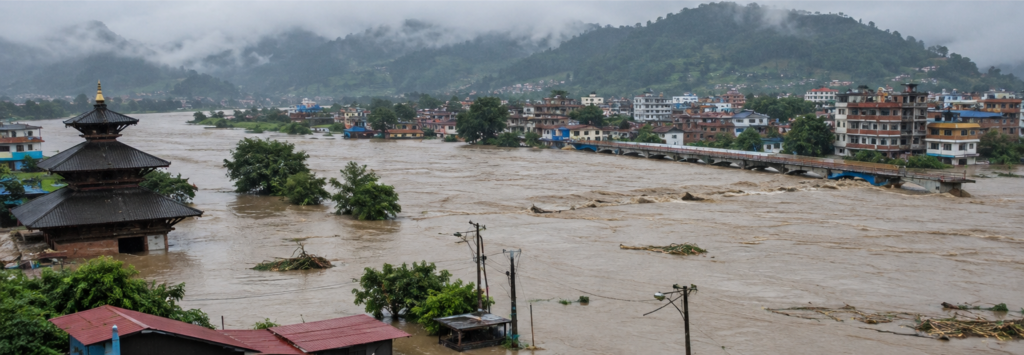
    Nepal has experienced several destructive GLOFs in the past. The 2024 flood in Thame, in the Everest region, demonstrated how mountain hazards can interact. Researchers found that a rock avalanche entered a glacial lake, generating a displacement wave and releasing a large volume of water downstream. The event destroyed homes, bridges and other infrastructure, highlighting the vulnerability of settlements in high mountain valleys.

    But glacier-related floods are only part of the picture.

    A warmer atmosphere can hold more moisture, increasing the potential for intense rainfall. When extreme rainfall occurs in steep Himalayan terrain, it can trigger flash floods, landslides and debris flows. These hazards can combine with glacier and snowmelt, making individual flood events more complex and difficult to predict.

    The risk becomes greater as roads, hydropower projects, settlements and other infrastructure expand into mountain valleys.

    Scientists caution that climate change does not mean every year will bring larger floods. Instead, it is changing the conditions under which extreme events occur. Flood risk depends on rainfall intensity, temperature, snow and ice conditions, river flow, terrain and human development.

    For Nepal, this means preparation must extend beyond traditional flood forecasting. Continuous monitoring of glaciers and glacial lakes, stronger early-warning systems, improved rainfall and river observations, and careful planning of mountain infrastructure will become increasingly important.

    The Himalayas are often described as Nepal’s natural water towers. As those frozen reservoirs shrink and become more unstable, the challenge is not simply to predict when the next flood will occur. It is to understand how a rapidly changing mountain environment is reshaping the risks downstream—and to act before the warning becomes a disaster.

    Share. Facebook Twitter Pinterest LinkedIn Tumblr WhatsApp Email
    Previous ArticleOne World, One Humanity: The Message of Universal Oneness
    Next Article Living Longer, Living Better: Everyday Habits That Support Healthy Ageing
    Impact Digital Desk
    • Website
    • Facebook

    Related Posts

    India’s First Indigenous ASF Vaccine: ICAR Scientists Felicitated for Landmark Achievement

    August 26, 2026

    Crop Diversification and Niche Crops

    August 11, 2026

    India Braces for a Dynamic Rainfall Season

    May 3, 2026

    Comments are closed.

    Demo
    Our Picks
    • Facebook
    • Twitter
    • Pinterest
    • Instagram
    • YouTube
    • Vimeo
    Don't Miss

    Captain Smit Machchhar: A Pilot’s Journey, Courage and Commitment

    By Impact Digital DeskOctober 5, 20260

    For Captain Smit Machchhar, becoming a pilot was not something he had planned from childhood.…

    Medicinal & Aromatic Plants Cultivation Promoted for Livelihood Security in Dima Hasao

    September 23, 2026

    Sensitization-cum-Training Programme on Self-Financing System Concludes at KVK Jammu

    September 17, 2026

    Beyond Textbooks: The Changing Face of Education in India

    September 17, 2026

    Subscribe to Updates

    Get the latest creative news from SmartMag about art & design.

    About Us
    About Us

    The Impact 24 is one of the largest and most widely trusted nationalist English news portals of Bharat, dedicated to delivering accurate, timely and
    impactful information.

    Email Us: editorimpact24@gmail.com
    Contact: +91-7005737184

    Our Picks

    India’s Education System at a Crossroads: Challenges, Change and the Road Ahead

    September 17, 2026

    Vermicompost: A Sustainable Boon for Modern Agriculture

    May 7, 2026

    4th Mithun Day Celebrated in Haflong with Focus on Integrated Farming and Sectoral Development

    September 4, 2026
    Menu
    • Get In Touch
    • Subscription Guidelines
    • Privacy Policy
    • Terms & Condition
    Facebook X (Twitter) Instagram Pinterest
    • Home
    • Politics
    • Technology
    • Buy Now
    © 2026 The Impact 24. Designed by TheImpact24.

    Type above and press Enter to search. Press Esc to cancel.